Case study · UNESCO, Zimbabwe · 2016–2019
Zimbabwe eSchools: ICT transforming education
How a three-year, $2M programme with Zimbabwe's ministries piloted a national e-school model, trained teachers at scale, and turned what it learned into national policy.
- Organisation
- UNESCO, with Zimbabwe's Ministry of Primary and Secondary Education and Ministry of Higher and Tertiary Education
- Funding
- Republic of Korea, through the UNESCO–Korean Funds-in-Trust
- Part of
- ICT Transforming Education in Africa, with Mozambique and Rwanda
- My role
- Managed the $2M programme in Zimbabwe for UNESCO
- 20pilot e-schools, two for learners with special needs
- 400+teachers trained in the pedagogical use of ICT
- 160+lecturers from all 14 teachers' colleges
- ~1,300open educational resources in a national repository
- 1national Policy on ICT in Higher Education, with masterplan
- 2017African Union award for the eSchools model
01 · Challenge
Start with the country's priorities
Zimbabwe was rolling out a new curriculum and wanted technology to strengthen teaching and learning in basic education, while widening access to quality higher education. The national priority was clear: strengthen ICT integration in basic education, and design an e-school model aligned with the national curriculum.
We began with needs, not equipment. Needs-assessment missions in March 2016 were followed by a workshop in Harare in May 2016, where ministry teams, UNESCO and Korean partners turned the findings into the country's work plan, so the programme was nationally owned from day one.
02 · Create
Design a model, not just a delivery
- A four-pillar e-school model. A ministry task team designed it around infrastructure, digital resources (with an emphasis on open educational resources), teacher capacity, and sustainability through monitoring, evaluation and learning.
- Mobile eClassrooms. Instead of fixed labs, schools received carts of networked laptops, a teacher laptop with class-management software, and a projector, prioritised for the classes starting the new curriculum.
- Inclusion by design. A dedicated needs assessment shaped assistive devices and digital materials for two special schools: one for learners with visual impairment, one for learners with a range of physical and mental disabilities.
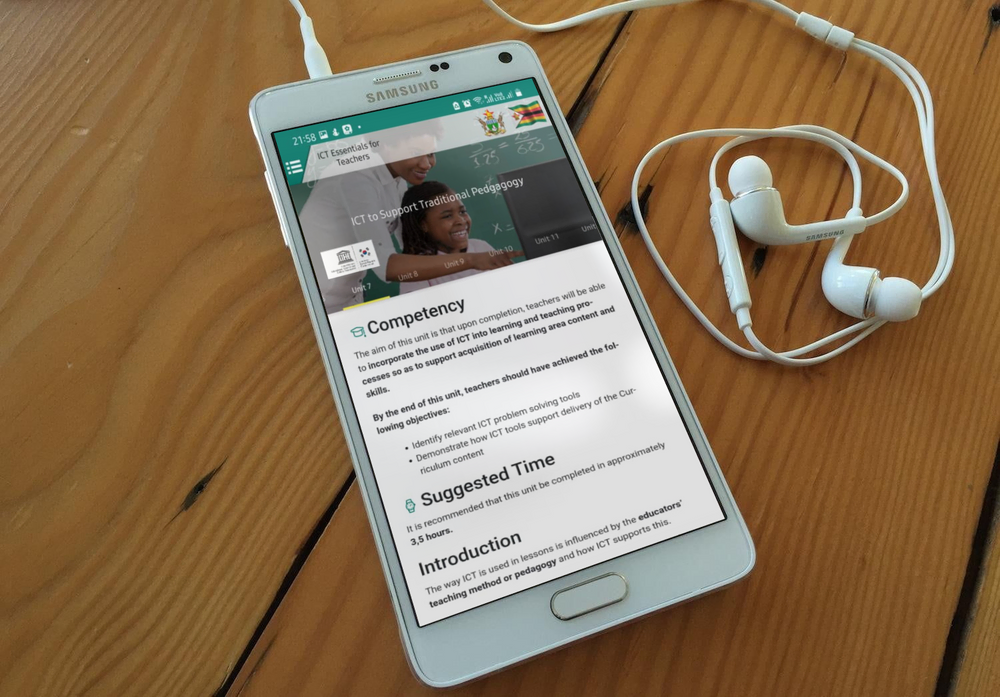
- ICT Essentials for Teachers. A 12-unit course localised from the UNESCO ICT Competency Framework for Teachers, finalised in September 2017 and available offline on USB, online, and through a mobile app.
- A curriculum-linked OER repository. Resources tagged to curriculum and syllabus statements, so teachers can search by the learning outcome they're teaching.
03 · Implement
Scale through people
- Cascade training. Forty trainers (an ICT focal point and a subject teacher from each school) were trained in October 2017 alongside officials from three ministries. By December 2017 they had trained over 400 teachers across the 20 pilot e-schools.
- Open resources at every level. Four workshops in 2019 built teachers' capacity to create, find and use open educational resources from infant level to A-level, growing the national repository to about 1,300 entries.
- Teacher education and higher education. 45 teacher educators were trained in 2016. A cascade of digitisation workshops (2018–2019) then trained 160+ lecturers from all 14 teachers' colleges to design digital instructional materials, including games and gamification. Masvingo Teachers' College was equipped as a model institution for open and distance learning, and librarians from every college were trained.
- From pilots to policy. A ministry-led task team, bringing together three ministries and other national stakeholders, developed a Policy on ICT in Higher Education and its implementation masterplan, built on six pillars from digital access and inclusion to innovation and research.
- Young innovators. Through the YouthMobile initiative, 26 students took part in a five-day design-thinking and app-development bootcamp; 21 showcased their apps at a Shark Tank at the University of Zimbabwe in March 2019.
04 · Investigate
Measure, learn, and hand over
- Monitoring with the schools. Visits and two meetings with the e-schools in early 2019 surfaced challenges and shared solutions, and each school produced a continuity plan covering resources, teacher development, digital content and partnerships, so ICT use would outlast the project.
- Measuring transfer, not attendance. I monitored effectiveness at Kirkpatrick levels 2 and 3: not only what teachers learned, but whether they applied it in their classrooms.
- Independent evaluation, next cycle. An external evaluation reviewed the project, and lessons from all three countries shaped a second phase in Côte d'Ivoire, Ghana and Senegal (2020–2023).
My role
What I led
- Managed the $2M programme and its partnerships with UN agencies, ministries, schools and universities.
- Led the eSchools pilot across 20 schools, two universities and a teacher training college.
- Convened the policy process behind Zimbabwe's National Policy on ICT in Higher Education.
- Localised the UNESCO ICT Competency Framework for Teachers and developed the ICT Essentials course for teachers.
- Monitored and reported on effectiveness using Kirkpatrick levels 2 and 3.
Takeaways
What made it work
- National ownership. Ministry task teams designed the e-school model and the policy; the programme supported them rather than replacing them.
- Cascades over one-off events. Training trainers multiplied reach and left capacity behind in every school and college.
- Inclusion from the start. Special schools were part of the pilot from the beginning, with their own needs assessment.
- Pilots that feed policy. What worked in schools and colleges informed national policy, so the gains could scale beyond the project.
Sources
Read the evidence
Download the final report (PDF, 5.6 MB)- UNESCO Digital Library · ICT Transforming Education in Africa: final project report (2020)
- UMC News · AU host workshop for next generation of Young Creatives
Figures are from UNESCO's final project report (2020) and Don's own records.